AIRMED : Transport of biological samples by drone
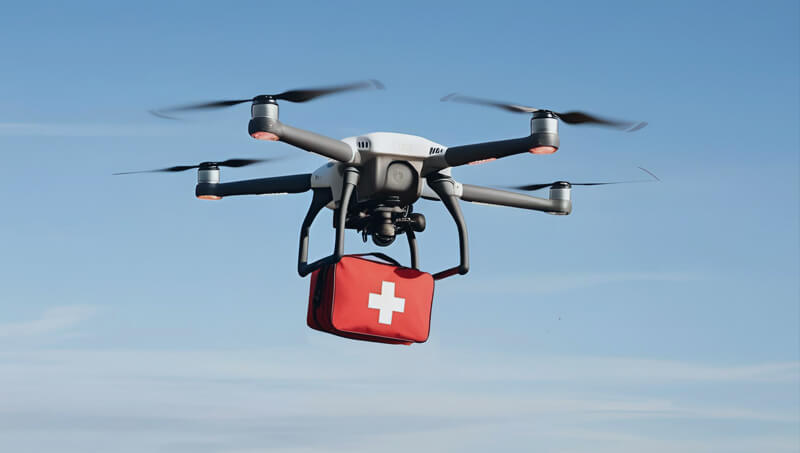
What if the future of medical laboratory testing took to the skies?
This is what the Rouen University Hospital (CHU de Rouen) in France is exploring, in partnership with Normandie AeroEspace (NAE), CEVAA, and Delivrone.
With the support of Métropole de Rouen
The project is funded by the Rouen Metropolitan Area through the TIGA (Territory of Innovation with High Ambition) scheme.
Transport of medical samples by drone
The concept of the transport of biological specimens by drone is currently generating significant interest within the medical biology and hospital sectors. Traditionally, such specimens are transported to centralized laboratory testing facilities by road. However, challenges related to traffic, delivery times, and carbon footprint are prompting the exploration of alternative solutions, such as the use of drones.
Furthermore, for any transport of biological material, two factors must be maintained: the required temperature and the proper preservation of the collected sample.
This approach also involves two technical aspects that must be examined: the risk of sample deterioration caused by vibrations during transport, and the potential for noise disturbance to the public.
Project Study with AIRMED
It is against this backdrop that the AIRMED project was launched to examine the project’s feasibility. The objective: to demonstrate the technical, economic, and environmental viability of an emergency medical transport service using drones in urban areas—a model that could be replicated in other regions.
The implemented use case involves transporting biological samples by drone over a distance of 4.5 km between two sites of the Rouen University Hospital (CHU de Rouen): Saint-Julien and Charles Nicolle.
The expected benefits include:
- Reduction of sample transport time from 45 minutes to 10 minutes.
- Removal of 8 round trips previously made via ground transport.
- A significant reduction in the carbon footprint, achieved by switching from combustion-engine vehicles to electric drones.
Acoustic and Vibratory Analysis by CEVAA
To validate the project, it is essential to determine, first, whether transporting blood samples by drone could cause them any damage. Second, it is necessary to assess whether the drone might create a potential noise nuisance for the public.
CEVAA, the vibro-acoustics expertise center of the 6NAPSE Group, was commissioned by NAE to conduct an acoustic and vibratory study on the transport of the container holding the samples via drone.
Impact of Drone Vibrations on Blood Samples
The initial objective is to determine whether drone vibrations could damage blood samples during future transport operations.
To this end, vibration tests are being conducted outdoors. Accelerometers have been placed on the drone—both on its structure and inside the transport container—to measure vibrations during takeoff, flight, and landing. Various flight configurations are being replicated: a standard cruise flight at a speed of 65 km/h at an altitude of 110 meters, and a second, highly turbulent flight—simulating stormy conditions—at various speeds and an altitude of 110 meters, encompassing both takeoff and landing phases.
Following this, the study involves replicating these intensified vibrations using an electrodynamic shaker, with the blood samples placed inside the transport case for subsequent analysis. CEVAA uses the shaker to reproduce these conditions in an extreme, controlled manner.
Impact of Drone Noise on the Public
The second objective is to assess whether the noise generated by drone transport between hospitals—specifically from Saint-Julien Hospital to Charles-Nicolle Hospital, where the biological analysis laboratory is located—could cause a disturbance to the public within the metropolitan area. To do this, it is necessary to conduct acoustic measurements of the drone in a location with low background noise. This allows CEVAA to precisely measure the noise generated solely by the drone.
Next, the drone’s noise level should be compared against the city’s ambient noise (based on the noise map for the Rouen metropolitan area). The objective is to assess the impact of the sound level on the population when the craft is flying at an altitude of 110 meters.
Partnership
The project is led by:
- NAE (Normandie AeroEspace)
- DELIVRONE, an innovative company specializing in the transport of healthcare products via drones
- Rouen University Hospital (CHU de Rouen)
- CEVAA, an engineering, testing, and expertise center specializing in acoustic and vibration analysis
This project receives financial support from the Rouen Normandie Metropolitan Area (Métropole Rouen Normandie).
