
VIRTUAL SHAKER
Vibration test simulation for the VECAME project
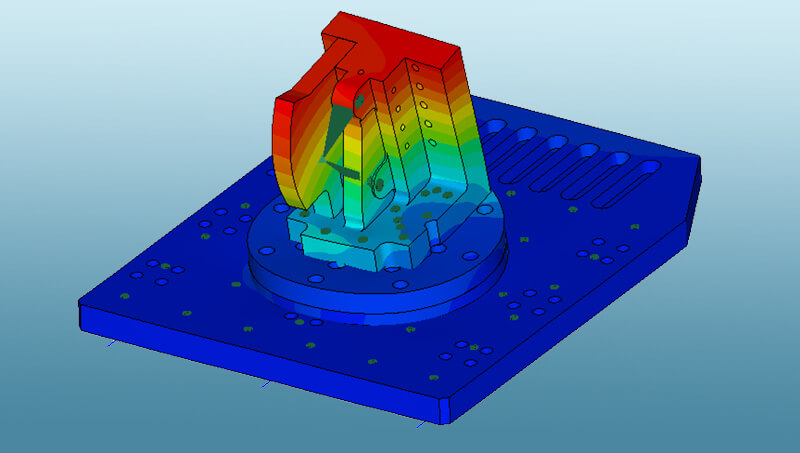
As part of the VECAME project, CEVAA is developing Virtual Shaker, a numerical simulation solution designed to faithfully replicate the dynamic behavior of a shaker during a vibration test.

With the support of CARNOT
The project is funded by CARNOT.
Vibration Testing and the Challenges of Numerical Simulation
In modern industry, validating the mechanical integrity of equipment against vibrations is an essential step. Whether in the automotive, aerospace, rail, defense, or even home appliance sectors, products are subjected to intense vibrational stress throughout their life cycle—from transport and engine vibrations to turbulence. To ensure their robustness, manufacturers rely on vibration testing.
A vibration shaker is the standard laboratory instrument used to subject a system to controlled vibrations—be they sinusoidal, random, or shock-based. However, this approach entails significant costs in terms of both time and money; building physical prototypes, mounting them on a test rig, and—in some cases—testing them to the point of destruction represents a substantial investment.
Transitioning from physical testing to numerical simulation would seem an obvious way to gain agility. Yet, creating an accurate model of a vibration test is a complex technical challenge. For a long time, such simulations suffered from approximations resulting from idealized boundary conditions and an underestimation of the actual deformability of the system’s components.
CEVAA’s Virtual Shaker
The primary technical objective of Virtual Shaker is to de-risk products at an early stage—well before a prototype is ever placed on a physical vibration test system (shaker). This proactive approach makes it possible to:
- Perform vibration fatigue analyses using 3D models to estimate the in-service lifespan of a component.
- Identify and rule out critical resonances that could weaken the test specimen or even lead to premature failure.
- Avoid unnecessary costs associated with the destruction of prototypes during unsuccessful tests.
One of the key innovations of this methodology lies in accounting for the dynamic behavior of the test rig itself. A vibration shaker is not an inert object; its mounting table possesses a degree of flexibility that varies depending on the size and technology of the shaker.
Rather than undertaking an overly cumbersome and unnecessarily complex model of the entire machine, the Virtual Shaker concept focuses on accurately replicating the system’s boundary conditions. By integrating the actual vibration characteristics of the shaker into the numerical model, the approach ensures a high level of representativeness.
Virtual Shaker goes beyond the component itself; it models and tests the entire chain—including the shaker, the surrounding environment, the tooling, and the part being characterized. This comprehensive modeling, combined with rigorous correlation against physical testing, ensures a high degree of confidence in the resulting data profiles.
To establish the robustness of this approach, CEVAA has conducted extensive research on virtual shakers based on various shaker technologies, including RT, HBT, and VST.
Thanks to this technological versatility, the project provides industrial users with a reliable predictive framework that bridges the gap between digital design and the reality of physical test platforms.
A study within the framework of the VECAME project
The development of “Virtual Shaker” is at the heart of the VECAME project (Virtualization of EMC and Vibration Testing for Electronic Modules). This initiative addresses the major challenges associated with the electrification of vehicles and industrial systems—challenges driven by the emergence of new components (such as power electronics and batteries) and by increasingly stringent regulatory requirements and operational constraints.
The project is structured around two complementary areas of virtualization:
- The virtualization of vibration testing (led by CEVAA, through “Virtual Shaker”).
- The virtualization of EMC (Electromagnetic Compatibility) testing (led by IRSEM), focusing on the modeling of conducted and radiated emissions.
The innovative principle behind this approach relies on the increasing integration of multiphysics models—covering both EMC and vibration—into tools that leverage technologies such as artificial intelligence.