
MORPHEUS: development of metamaterials for acoustic stealth
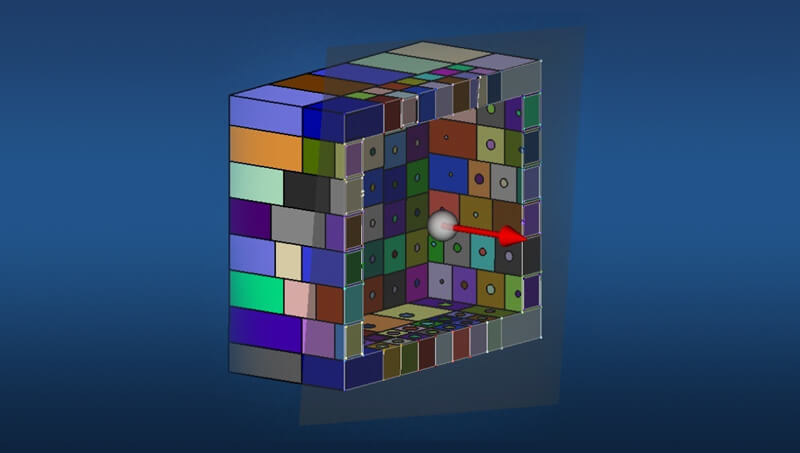
CEVAA has created MORPHEUS to develop metamaterials for limiting the sound frequencies emitted by vehicles.

With the support of CARNOT
The project is funded by CARNOT.
The Challenge of Acoustic Stealth and the Opportunity Offered by Metamaterials
For a military vehicle, emitting noise is tantamount to revealing one’s position. Acoustic and vibrational signatures are now actively exploited by adversary detection systems. Consequently, reducing these emissions has become a top-priority objective.
Traditionally, acoustic attenuation has relied on dense, heavy materials (such as rock wool, cellular foams, or heavy mass layers). These solutions quickly reach their limits: they add significant weight to structures and prove ineffective against low frequencies—which, according to the well-known “mass law,” would require prohibitively thick layers of material.
The Revolution of Metamaterials and Geometry
This is where metamaterials come into play. Unlike natural materials, their exceptional properties are not derived from their chemical composition, but rather from their internal geometry.
Designed at either the microscopic or macroscopic scale using complex, periodic patterns, they enable the manipulation of waves in unprecedented ways. This is made possible by a negative refractive index, which allows them to deflect, bend, or trap acoustic waves. By carefully structuring matter, it also becomes possible to encapsulate various sources, trapping sound energy and preventing it from propagating outward. Furthermore, their compact nature offers remarkable attenuation performance at low frequencies without adding significant weight.
MORPHEUS Project
The MORPHEUS project aims to structure and accelerate the development of these disruptive technologies.
The chosen technology: an array of Helmholtz resonators
To achieve this, the selected technology relies on the intelligent use of arrays of Helmholtz resonators, designed to effectively target and trap one or more sound frequencies. By assembling these resonators into an array within a structure, the array itself functions as a metamaterial. By adjusting the geometry and dimensions of each individual element, it becomes possible to target one or more frequencies simultaneously.
To limit the need for physical prototypes and ensure reliable numerical models, the project employs a rigorous methodology: designing unit cells, conducting predictive simulations, performing experimental tests followed by model calibration, and finally assembling multiple cells. Furthermore, MORPHEUS takes a comprehensive approach by addressing both structure-borne and airborne sound paths, as structural vibrations directly influence the acoustic frequencies that are emitted.
Partnership
The project is led by CEVAA, 6NAPSE TESTING, and Altran Prototypes Automobile.
